Show Notes
What happens when a teenage drum-flipping side hustle becomes a remote ecommerce business—and its founder follows that freedom from the United States to India and Thailand? In GFA496, Mike Michelini talks with Zach about vintage instruments, cross-border operations, visa lessons, and the decentralized domain system that brought them together.
Zach began buying, restoring, and reselling vintage drums as a teenager. That early experiment grew into Counterhoop, a Michigan-based business supported by a team handling restoration, inventory, packing, and shipping while Zach works abroad.
What We Cover
- How a first profitable drum flip became a specialized ecommerce business.
- Why collectible products can reward deep category knowledge and careful restoration.
- How Zach built a team that keeps physical operations running while he travels.
- What he learned from living in India, handling visa mistakes, and spending time in Thailand.
- How Handshake offers a decentralized approach to top-level domains.
- Why transparent auctions, resolvers, adoption, and post-Namebase tooling still matter to the Handshake community.
- How Zach is experimenting with a tool for scheduling and placing Handshake auction bids.
About Zach
Zach runs Counterhoop, a vintage drum and percussion business based in Michigan. His surname and any additional biography remain pending guest confirmation before publication.
Disclosure and Verification
Mike is involved with HeadlessDomains and the Handshake .agent top-level domain. The episode includes personal opinions and provisional technical, pricing, policy, and market claims that must be checked against primary sources before publication. Nothing in this episode is financial, legal, immigration, or investment advice.
Full Episode Transcript
[0:47] Um So I'm here in my in the home studio here in Chiang Mai and I got to know Zach.
[0:53] Hello.
[0:54] Welcome to the show.
[0:55] Thanks for having me.
[0:56] Yeah, man.
[0:57] So I think it's a cool show where we'll talk a little bit about your background, some of your e-com experience, some of this handshake.
[1:04] I got both the banners here.
[1:05] It's represent the banners here, and then you know, get some stories.
[1:10] You know, the
[1:12] on-the-ground, but we say here,
[1:15] global from Asia, but we report the global from anywhere.
[1:18] But the on the ground, people on the ground here on the ground between India and now in Thailand doing cool stuff.
[1:26] But originally, South Dakota, I don't know if you want to share some of your stuff.
[1:30] Yeah, so I grew up in South Dakota and that's where I started my business.
[1:36] So I I restore vintage drums, percussion instruments, and basically like old classic rock drum sets, so like stuff that Rigo Star with the Beatles played, or John Bonham, like not the exact drums they played, but the same, well, the same types, like the same model, uh, same, I don't know, size or color, like there's all these details
[2:04] people look for when they get a drum set that makes them collectible.
[2:08] Okay.
[2:08] Kinda like names, you know, handshake names.
[2:10] There's the
[2:11] the numbers, the letters, the emojis, there's like, I don't know, the different categories of drums too.
[2:19] Interesting collectors.
[2:20] I mean, it's a good industry, I think it's I think it's AI safe-ish because it's collectible, it's got a story, it's made of what, Henry, made in the US, made in the Asian.
[2:34] Most of them are made in the U.S.
[2:35] Oh, so the drum history is kind of interesting too.
[2:40] Like, most early 1900s is when the modern drum developed, and it was mostly in the U.S., like New Orleans, where Jazz was getting going, and that's where they like originally it was a street band where one person had a bass drum, one person had a snare, one person had a cymbal, and then they combined it all into
[3:00] one person playing all these instruments, and then it kind of goes all from there.
[3:06] I kind of think of the set, you mean, right?
[3:07] Yeah, like that's how a drum set came together in a jazz band where one person was doing each thing, and then they just like put it all together so you could do something with your feet and your hands.
[3:19] Cool.
[3:20] And you started this your how long?
[3:22] 15?
[3:23] Yeah, so I was 15.
[3:25] I had a minimum wage job.
[3:27] I was working at a nursing home, $5.15 an hour.
[3:33] It was nice.
[3:35] I could walk to it from my house.
[3:37] So just like a 10-minute walk, put on my bow tie and my like nice white shirt and black pants.
[3:45] But I don't know.
[3:47] It was like a month of work and you'd make what a few four hundred, want $500.
[3:54] Depends on how many hours.
[3:55] If you're working part-time, part-time, so like $20, you know, there's tax, but it's like $100 a month a week, $20 times something like that.
[4:04] Yeah, it's enough for us, like, it's good when you're 15, but
[4:10] yeah, yeah, something like that.
[4:12] But so I was a musician, like I grew up playing violin and piano.
[4:19] Like, my parents started me playing violin when I was six.
[4:22] And so music was always part of my life.
[4:26] But I never really liked the instruments I was playing too much.
[4:30] Like, I was playing classical music, doing lessons, and it was okay.
[4:35] It was just like, it wasn't the music I listened to.
[4:37] You know, it was like listening to rock and metal and Prague and stuff.
[4:42] It was like spending all my musical energy playing classical music, which is it's fun, it's good for learning, like good for the brain, but drums was like I was like, this is awesome, this is so much fun and so I was like looking for the sound I wanted, and I think I bought like three or four drum
[5:02] sets and sold them at this point.
[5:04] Just like entry-level stuff, trying to figure out, like, I don't know, you level up as you play more and learn more.
[5:12] So
[5:14] eventually I read online like some drum forms, old like these boomers were talking about their favorite drums and like uh I came across vintage drums and I bought a drum set.
[5:27] I ended up not really liking it either, but I sold it and flipped it and made like I think I made like $700 off what I had originally purchased it for.
[5:39] For me, yeah, that was like two months of work at that point.
[5:43] And it took me like maybe a few days of work, like actual cleaning the thing up, like sourcing some parts that was missing, and I was like, This is kind of fun.
[5:53] I'm a drummer at like trying out the different brands and models that are out there, and even if this one wasn't for me, like there's such a variety out there that I like put this money I made into buying the next drone set.
[6:09] So I kind of did that and it snowballed.
[6:13] And the next drone set was actually from Europe.
[6:16] It was a a brand called Premier.
[6:19] It's made in England.
[6:20] I think I've I even I've heard of I think I've seen those.
[6:23] Yeah, they're they're really nice.
[6:25] They also go way back, like early 1920s or so.
[6:28] I can see that.
[6:29] Also, Germany, Sonar, they have a company that goes way back to.
[6:33] So it's not all American, but American, kind of England and Germany were some of the big countries making drums.
[6:43] But then it all changed in the late 50s, early 60s, and Japan got into the market.
[6:50] So, all the American companies would base their product tier on like these variations in hardware, like you'd have less hardware on the drum and it'd be cheaper.
[7:05] You're making me think of the cars now.
[7:07] Yeah, it's probably a similar story.
[7:10] Like, maybe the engine was still good, yeah.
[7:12] Like, the US cars and West European cars have all these add-ons and accessories, and they charge you upsell you all this, and then the Chinese now just give you everything.
[7:21] Like, yeah, like there's no choice.
[7:25] Like, a huge
[7:26] discount, so price.
[7:28] Yeah, just make one with everything and mass produce it.
[7:32] Yeah.
[7:33] Yeah, so with drums, like the Japanese drum producers kind of came in with an entry-level drum set that was priced like half or a third what the American companies would sell for.
[7:50] And so they just it put on this pressure on the American market.
[7:55] And by the 70s, like most of the American companies were out of business, or their product had declined to such an extent that while the original Japanese drums product was definitely inferior, there was this switch point where the Americans' companies competing with the Japanese lowered their quality enough, and the Japanese companies increased their quality enough that, like,
[8:19] by the 70s, they were the better quality product.
[8:22] In the 70s and 80s, they ascended to like become a few of the biggest drum companies in the world, or then Japanese companies, and it kind of changed the game.
[8:36] So, what I specialize in in vintage drums is kind of the era while that was happening and before.
[8:44] So like I usually look at early 1900s to 1970s drums.
[8:50] Interesting.
[8:50] Plus or minus.
[8:52] Okay.
[8:53] Really cool.
[8:55] And yeah, so you have a team in the US, right?
[8:58] In Midwest?
[9:00] Yeah, so I'm based in Michigan.
[9:02] I have two great guys there who are managing the business for me.
[9:07] They do all the like warehouse work.
[9:11] So packaging, shipping, doing orders, inventory
[9:16] also they do a lot of the restoration now so we get a drum in like sometimes it looks like it just came out of a flood or a hurricane like you you'll find these old metal drums.
[9:29] I mean, other times it's like something that's been sitting in a case that hasn't been opened in 30, 40 years, and it just needs kind of a polish.
[9:38] So you get
[9:40] all states of conditions, but we deal with them all.
[9:43] We'll clean them up, get the rust off, get all the corrosion off, get them shiny, put new drum heads on, make them like usable and complete.
[9:55] So, like, a new drummer could buy it, play it, and put, you know, decades more use into this drum.
[10:02] It's still a quality instrument, still, like, less less money than you would get like, you could probably get a medium range drum brand new for what you can get, like the top of the line cleaned up restored vintage drum.
[10:21] So I think it's they're really a great
[10:25] deal.
[10:25] Like, if you're a young drummer or for anyone who wants to try drums, get into drums, I always like, whenever I have a friend or family who's like they're wanting to get into drums and their kids want to get into drums, I'm like, look into vintage drums.
[10:40] There's definitely some models, different things to look at, but I think they're the best sounding like instrument you can get for you know, your money goes a long way.
[10:50] Nice.
[10:51] Okay, and then, you know, we're here in Thailand and even in India.
[10:56] Where's what's the story?
[10:57] How did you get over here?
[10:59] So, uh, let's see.
[11:02] I came over to India last year in February, so I'd kind of always wanted to come to India.
[11:12] Uh I went to college and like two of my best friends were from India and they were just like wild dudes that I was like where where are these guys from?
[11:22] I gotta see, I gotta see for myself, sorta thing.
[11:25] And then, also, like, I got into health aspects of like Ayurveda.
[11:32] I started learning about that.
[11:34] So, I went to after South Dakota, I went to college in California, and then after that, I moved to Northern California for a couple of years.
[11:44] And so, kind of got exposed to the hippie culture side of things there.
[11:49] I got some like natural living stuff.
[11:51] So, is it like just two jobs India trip or what?
[11:55] Um, I don't know.
[11:57] it's many things, so like that was always part of it, like since 2013 or so, learning about Ayurveda.
[12:04] I was like, this is amazing.
[12:05] This is such a cool health modality.
[12:08] I want to learn more about explore it.
[12:11] And so that was those two things were two reasons.
[12:15] And then, third was I had like a somewhat of a family connection where my parents had spent a semester like right after they got married, kind of like a honeymoon thing in Bangalore back in 1981, and so that was always part of my upbringing: hearing their stories about that.
[12:36] And then, like, while they were here, my mom learns to cook curry and stuff, so, growing up, eating a lot of Indian food too it was like it's always one of my favorite cuisines and also I'm vegetarian and depending on where you are in the world it's like that can be its own thing.
[12:55] But I was in Michigan before this, and like it's also within a state, like in the big cities in Michigan, you can find great vegetarian food.
[13:04] But if you're in some rural area, you're cooking for yourself, or you're.
[13:09] I don't know what you're doing.
[13:10] I was thinking that they had, yeah.
[13:12] So, I don't know.
[13:13] That's a big part of it.
[13:14] Like,
[13:15] being there is just like great food.
[13:19] I think probably in the world, or at least in the countries I've been to, best vegetarian food, like it's kind of the majority of people, it's the dominant cuisine, I guess.
[13:33] And then meat is more like a a side thing, whereas most other places, like meat is the main thing, and you might be able to find some vegetarian food.
[13:41] So, I don't know.
[13:42] That was that's not why I moved there, but it was uh one of the things that's definitely kept me there past my original six-month visa.
[13:52] Yeah, I think it's fun to share, if you're willing, about the visa.
[13:56] I mean, this is part of the on-the-ground experiences in a
[14:02] being a digital nomad or like someone in a country where it's not your home country.
[14:07] It's something you have to deal with.
[14:08] So I'm happy to share about it.
[14:11] I think that would be fun to hear some of the
[14:14] sorry.
[14:15] I don't know.
[14:15] I should definitely have been smarter about my whole visa process or at least more aware of the rules.
[14:22] But when I first went there, I got a visa for a year, and then my understanding of it was it was like six months at a time.
[14:32] And so I thought if I left the country and came back, it would restart.
[14:36] But it turns out it was just like a six-month total within a year, and so I left the country, came back thinking I could stay like another six months, and I think total I had stayed six months and seventeen days or something.
[14:52] By the time it came or I was like going home for Christmas or something.
[14:57] And so I was at the airport, like, you go through immigration first, you talk to the immigration officer, and they're going through all my papers, and they're just like, Well, you gotta talk to someone else back there.
[15:14] Yeah, so they they charge you a fee.
[15:15] This was like
[15:17] uh fifteen K rupees, which is roughly like a hundred and fifty dollars or so.
[15:25] So I was like, yeah, seventeen days, it's not the worst, like, okay, whatever.
[15:30] Um, and then I apply for my second visa.
[15:34] So, uh, last when was this the beginning of this year before coming over, I applied for another tourist visa, same visa that I'd got the first time, and
[15:52] that one it wasn't as smooth as the first one.
[15:55] Like the first time I applied, I got it approved within like three or four business days.
[15:59] Nothing else needed.
[16:01] This time, they sent me an email back where they're like, We need more information to process your visa, which is never a good thing, but luckily it was easy.
[16:11] Like, I sent them this extra information, waited a few more business days than the last one, and I got approved.
[16:19] But this time, like, I overstayed my visa by one day.
[16:25] So I was planning on leaving.
[16:27] I, like, I had the date in mind.
[16:29] I got here, I think it was the 21st of January or something.
[16:35] So I was planning on leaving the 19th.
[16:38] I was like 21st of January to
[16:43] 19th of what is it?
[16:45] July.
[16:46] I was like, that I think that's six months.
[16:50] And the problem was, though, that I got to the airport at, like, near midnight.
[16:56] And so, by the time I had gone from my gate that I landed at through security to where immigration was, it was already 12:30 in the morning.
[17:10] And they were like, sorry, bud, it's 91 days.
[17:15] That's some.
[17:16] That's some PS.
[17:17] And so I was like, I don't know.
[17:21] I should have been nicer for the moment.
[17:23] The passport.
[17:26] That's what I should have.
[17:28] Uh 90 days, maybe?
[17:31] I think it's 90, isn't it?
[17:36] I got in trouble for that once, actually.
[17:38] You tried to.
[17:40] So I
[17:43] had, I would say, there's so much cash, but sometimes I just stick cash in different parts.
[17:47] Like, I distribute cash sometimes when I'm traveling, and I see it.
[17:49] You like your pocket with other stuff.
[17:51] Yeah, I stuck some in the back of my passport or maybe in the front of my passport.
[17:54] And I'd forgotten about it.
[17:55] You know, it was in there.
[17:56] It's not like it was, I put it before, but I gave it to the customs official and she opened it.
[18:01] This thousand bop bill.
[18:02] And she immediately just pushed it the bill back across the counter to me, like, like, like reflex, like, push back.
[18:10] I was like, oh, sorry, sorry, you know.
[18:12] I'm like, yeah, to mean to, yeah, I was like, I'm not trying to She just I was like she just she kinda like eyes lit up, it was a female custom, she just pushed it back at me.
[18:23] I'm like, damn, okay, I didn't do that on purpose.
[18:28] But that might have worked.
[18:30] I mean, next time, I'll give it a try.
[18:35] So basically, I overstayed two tourist visas.
[18:40] I had come to Thailand originally on a visa run.
[18:44] So, like, that was the whole reason I planned this trip in the first place.
[18:49] Was like, I know my sixth month is coming up.
[18:52] I gotta go while I'm in Thailand, I'll apply for a business visa.
[18:57] I have a business, I've been working on business while I've been in India, and I was like, hopefully, it works out.
[19:05] But that got rejected, and
[19:09] so the first time I applied, I think it was actually just some stupid error I made.
[19:16] So, to be completely honest, like they asked for your current address or something, and I think I had put my current address in India, like where I was residing.
[19:29] Like, I had a rental that I was living at, and so I was like, okay, they want to know where I've been living.
[19:37] So I put that, and then I was looking at it later, and I was like, no, they mean where you're actually presently at when you're applying for this thing, which would have been like whatever Airbnb I was staying at for that night in Thailand.
[19:51] And so I think that was enough maybe for that to get rejected.
[19:55] Because it's like if you put a current address in India, you can't apply for a business visa while you're in India.
[20:03] So, I don't know.
[20:05] I was like, it should have flagged it or been like, hey, this is India, you can't enter this.
[20:10] I'm not trying to plug visa agents, but maybe
[20:13] there are some that the visa agents might know.
[20:16] Yeah.
[20:17] It's just in hindsight,
[20:20] Vietnam.
[20:21] I do Vietnam a lot lately, and you know, with the US, I have to apply every time.
[20:27] And then it's like pages and pages of questions, you know.
[20:30] Yeah.
[20:31] And actually I'll be honest, I wasn't luckily it work I I don't know if I should say this but yeah, I wasn't perfect about present address and stuff.
[20:39] Yeah.
[20:41] For me.
[20:42] I mean as long as it's not the
[20:45] not as big an error as like applying the same country or putting India, true.
[20:51] Yeah, probably fine as long as it's in an address in the right country.
[20:56] We'll get to hang out, though.
[20:58] Yeah, no, it worked out for the best.
[21:00] And so I've kind of been rolling with it.
[21:03] And maybe this is just, you know, part of the digital nomad experience to
[21:08] roll the bunches.
[21:09] Yeah, you saw some places, some people and places last couple of days.
[21:13] I think really it's worked out for the best.
[21:15] And at this point, it's like, you know, every once in a while, you're just like, uh, you know, I should have done this right, or I should have planned more, or hired the agent, but then again, like, maybe doing that, it wouldn't have led to this situation here in my life.
[21:31] Butterfly.
[21:32] Butterfly effect.
[21:33] Yeah.
[21:34] Or everything, just destiny, or everything happens for a reason.
[21:38] Yeah, that's part of the story.
[21:41] You know?
[21:42] You know, that's part of the part of the path.
[21:44] yeah.
[21:44] And it's it's funny, because I I have a family friend in Chiang Mai.
[21:48] So my dad knew someone, and before coming to Thailand, he's like, hey, you should meet up my friend.
[21:54] He's been living in Chiang Mai like eight months or so.
[21:58] Cool.
[21:58] If you're going to Thailand, hit him up.
[22:00] And so I hit him up and I was going to visit.
[22:02] But this visit, like, if I had got approved, I went to the islands, I went to Cotau, Cofangia, the that area.
[22:12] What do you think of those?
[22:13] And it was it was awesome.
[22:16] Very beautiful.
[22:17] Tourist areas, right?
[22:18] Or yeah, very touristy.
[22:21] But I mean, I understand why they're so beautiful.
[22:28] I don't remember what it's called.
[22:29] Maybe Cowsauck.
[22:31] I think Cowsauck National Forests, maybe..
[22:34] Alright But there's a, I think it's Lake Wen near that.
[22:38] And that was definitely the highlight, I think.
[22:41] Like, the islands were amazing.
[22:43] But this, like, you
[22:46] go to this place where they take you on a boat and like boat you an hour away from wherever the starting point is
[22:56] to this village that's like a village on this river, and I guess back in the day, like some ancient kingdom, there's this mountainous area with these really cool like peaks and mountain tops, and they just flooded the whole thing.
[23:12] So it's a man-made lake that then people live on the lake, and I don't know.
[23:19] I don't know what they do, fishing or just tourism mainly.
[23:22] But it's a beautiful place.
[23:24] They have kayaks they can use and swim, and they do activities like you go into a cave, and that does sound nice.
[23:33] There's like a waterfall hike that was crazy.
[23:36] So, that was that was one of my favorite parts, and then just, like you meet other foreigners traveling around too, who are there doing the same adventure sort of thing.
[23:46] Great.
[23:47] So that was fun.
[23:48] Okay.
[23:50] But, yeah,
[23:51] if it had all worked out and I had got my visa, that would have been the end of the trip.
[23:56] Like, I wouldn't even have made it to Chiang Mai this trip.
[23:59] I was like, I wanted to see my family friend and like do everything in one trip, but I was like, Yeah, it's I don't wanna rush it and pack too many things and so I was like, Oh, just meet him the next time I'm back in Thailand.
[24:14] But this visa thing it all ended up working out, so there you go at this point.
[24:19] Yeah, I'm still working on the visa situation, but I'm also like, I don't know, Thailand's nice, Chiang Mai is very peaceful, very calm, and
[24:32] I don't know.
[24:33] Thai food's growing on me too.
[24:35] I've always liked it, but there's some good stuff here.
[24:38] Yeah, cow soy.
[24:42] That is, I guess they have the non-meat version, right?
[24:45] Or what?
[24:46] They do have a yeah, so at least there's a vegetarian restaurant, I found has a vegetarian cowsoy, yeah, vegetarian cowsoy with some sort of mushrooms that are really good.
[24:57] And then I usually get it with an omelette, like an egg on the side.
[25:02] yeah.
[25:03] So you get some protein.
[25:04] There you go.
[25:06] Cool.
[25:06] And then I guess we can switch it to the handshake web 3 side, this side of the background.
[25:13] Yeah, but you're things and handshake.
[25:17] Yeah, so we've had some shows on Globe of Mesa.
[25:20] Of course, we have the Sky Include channel too, which is a lot more tutorials.
[25:25] But Handshake is an alternative route to, I guess, ICANN, or what would you call it?
[25:31] The traditional route
[25:34] domain system.
[25:35] Yeah.
[25:36] Kind of like how Bitcoin kind of disintermediates the
[25:44] reserve banks.
[25:45] Or treasuries.
[25:47] Central banking.
[25:49] Yeah, Central Reserve, the handshake disintermediates ICAN in some ways.
[25:54] Where it's like you don't need centralized authority to grant you
[26:03] or I mean to approve your two hundred thousand dollar or so application for a TMD two something ridiculous amount of money that no most individuals can't afford to get your own T L D.
[26:15] With Handshake you can get a T L D and operate it yourself for like some of 'em you get these T L D's for pennies, for nothing, yeah, for free basically.
[26:26] And just to be clear, I think blob, we know TLD, top-level domain, like right at a dot, like dot com is a TLD, so com.
[26:34] And com, you might not know, most people don't know, you maybe know GoDaddy, right?
[26:39] But GoDaddy doesn't really own.com, they are a reseller or a registrar.
[26:45] So you go to GoDaddy or whatever, you know, Name Cheap or whatever, you buy a domain, you're paying Name Cheap or GoDaddy, but they pay VeriSign.
[26:54] And VeriSign is a registry that owns.com, and I think they have.NET and some others.
[27:02] And then, uh, so it's actually kind of complicated to be honest.
[27:07] I'm trying to not go so deep.
[27:09] Yeah, this is deep.
[27:10] But then
[27:11] ICAN is
[27:14] technically a non-profit, but I've learned about non-profits.
[27:17] I think non-profits are like, what's a non-profit?
[27:20] Basically, a non-profit means they don't keep the profit in the company.
[27:24] The money goes somewhere else.
[27:26] But that doesn't mean it goes to good things like, right?
[27:30] Like, I've learned this the hard way with a lot of things.
[27:34] And that's why, actually, if you if you try to do a non-profit in a lot of countries, it's like high risk.
[27:39] Like, they don't let you.
[27:40] Like, in Thailand, it's like high fraud.
[27:44] So many frauds in non-profits.
[27:46] It's like harder and more regulated.
[27:48] Because people use this as like a front.
[27:51] Like money laundering or scamming or it's like a cover they
[27:58] say I'm a non-profit, I'm not profit, and but the profit just goes to the you just salary it out.
[28:02] Yeah, you just pay salary or don't I don't want to speak of other non-profits, but I've been associated or work with non-profits and they just have to spend the money at the end of the year.
[28:14] That's the basically what a non-profit is.
[28:16] Like, it's so keep profit.
[28:18] Yeah, so it doesn't necessarily mean they're, you know, looking out for our best interests as like, I don't know, random users of the internet or people who have businesses.
[28:32] I'm sure anybody who has a domain name is paying more this year than last year.
[28:37] It probably ever goes down.
[28:39] That's it.
[28:40] No, definitely not.
[28:41] Never goes up less than 10%.
[28:43] Yeah, right?
[28:44] There's even been some, I don't know if it'ss lawuit or people contesting it, but yeah, Verison basically, I would consider it a monopoly.
[28:51] I mean, I don't know.
[28:52] I still prefer dot-com.
[28:53] I don't know about you.
[28:54] I think most people say it's the default.
[28:56] It's the standard.
[28:57] Yeah, it definitely is the increases every year.
[29:00] So some people say it's a monopoly 'cause VeriSign has the only is the only company that issues them.
[29:06] And they increase them every year.
[29:08] And then I think they say, Well, no, it's not really because you can use dot something else, like dot whatever.
[29:15] But most of us still pay doc, and it's your domain.
[29:17] You're not gonna just stop using your shop.
[29:19] If you have a domain already, you're not gonna switch to another one.
[29:22] Yeah,
[29:24] it's a thing for brand recognition too.
[29:26] Like if you if you tell someone your company and they look you up online, most people would assume it's your company dot com if you don't tell them it's dot AI or dot something else.
[29:40] But yeah, so a little bit off the track there, but you know, I mean, you know, I think anybody who gets involved with Handshake starts to learn this because I didn't know this so well.
[29:50] Of course, I knew domains, but I didn't notice before I got into the Handshake system.
[29:55] And so, yeah, Handshake's an alternative to that.
[29:58] And it's a blockchain, right?
[30:01] I know people have bad impressions on blockchain.
[30:04] A forgive of Bitcoin.
[30:05] Yeah, it's basically using Bitcoin technology to be purely for domains.
[30:11] And it's it like kind of follows Satoshi's original vision either 'cause he he like specced out Namecoin basically.
[30:18] And it was one of his original first ideas of how you could utilize a blockchain, this new technology.
[30:25] It was
[30:26] with naming.
[30:27] It's so fundamental.
[30:28] Yeah, he talks about it on Bitcoin Talk, I think, as the forum.
[30:31] He said, Okay, yeah.
[30:33] There's posts about him talking about Nimcoin and the next project is domains.
[30:37] Okay, we got the banks and the money now.
[30:39] Let's go to the memes.
[30:41] Yeah, so I mean, so Bitcoin, hopefully, it's still a success.
[30:45] Like, I think we just had this upturn recently.
[30:49] That's nice.
[30:50] Yeah, we're here in like just put the date in late August.
[30:55] Yeah, it's about like seventy five, seventy six thousand recording this.
[31:00] It's been in the low sixties, so it's been depressing for a lot of people.
[31:04] So Bitcoin it's it's like it's had its success.
[31:08] It, you know, maybe, you know, I don't think the Central Reserve or all these banks are really disintermediated at this point, but it's like maybe there's still
[31:21] work to be done.
[31:22] It's had its start.
[31:24] It's slowly disintermediating, maybe.
[31:28] It's like what?
[31:28] 1% currently just said they're using it, or they're holding it, and U.S.
[31:33] holds some, and But yeah, it''ss true.
[31:36] There this whole battle between SOV or store of value versus using it as money or cash.
[31:42] Yeah, using it as a currency versus like an investment.
[31:44] Like Michael Saylor will say, I seem to see Eclipse, he's like, guys, you guys are such, I forget what the word is, you know, like purists or so crazy.
[31:55] You're not going to get rid of the dollar.
[31:57] You're not going to, you know, he's saying it's a store of value, it's a hedge against it the dollar,'s hedge against inflation.
[32:03] But a lot of the more hardcore people, I kind of put myself in there too.
[32:06] Yeah, same here.
[32:08] I was like, no, man,
[32:09] we're going all the way, man.
[32:11] Like, it's not just something you just put in your freaking computer and uh right, you're supposed to use it.
[32:17] That's the whole point.
[32:18] I I think it's just it's still so early.
[32:20] It still doesn't seem that way 'cause everything's still priced in all these other uh what do they what do they call them?
[32:27] The currencies.
[32:29] Fiat.
[32:30] All the other fiat currencies.
[32:31] We all live under those regimes.
[32:34] It's unbelievable, man.
[32:35] It's like I tell my kids it's like monopoly, and the banker can just print and just pass out more to that is literally how it is.
[32:42] People accept that, right?
[32:43] And that's the parallel to handshake too, is that's literally how handshake is to some extent.
[32:49] It's like, so this one of the most newest developments, I would I think in the handshake ecosystem is like related to ICANN, is ICANN decided to release new TLDs and so I don't know, handshake is like it's a weird thing having two naming uh communities I guess that are kind of doing the same thing, issuing the names.
[33:16] Little because I think we're deep in it.
[33:19] So, ICAN, which is basically a main or primary or mainstream domain system, hasn't issued new GTLDs, global top-level domains, since twenty twelve.
[33:33] So that was sixteen fourteen years ago.
[33:36] Fourteen years ago.
[33:38] And I think Handshake was started to be designed in twenty seventeen or twenty eighteen more formally and publicly.
[33:45] I actually got to know the creators, it's pretty cool.
[33:47] And
[33:50] it went main that 2020 thinking maybe ICAN won't issue more TLDs in the future.
[33:55] There was this whole thinking, maybe because handshakes out, maybe they they actually the coolest thing, I think you like it too, is there was a lot of allocation of coins to ICANN, to VeriSign, to GitHub developers.
[34:08] There was a huge chunk of the coin reserved for all these people to claim.
[34:13] That's to me, that's another one of the coolest parts about Handshake.
[34:17] I don't know, on one side of it, as a, like, before getting into handshake, I was a Bitcoiner.
[34:24] And as a Bitcoiner, it's like, you have this gut reaction to any non-Bitcoin things, all the shit coins, that whole thing.
[34:32] And it's like, even talking about any non-Bitcoin, like, handshakes.
[34:36] You have that, it's always in the back of the mind.
[34:38] It's like the Bitcoin just thinks.
[34:41] Yeah, they do.
[34:42] They don't listen to us usually.
[34:44] But really, it's, I don't know.
[34:45] To me, if there's one other coin besides a Bitcoin that's worth looking at, or like has obvious value, it's it's handshake, and that's the whole uh way they uh kind of developed it is part of that, and it goes along with like setting aside funds to ICANN to Barasign.
[35:06] Like the founders, the creators of Handshake, all the investments they got, they pretty much put 90-something like a big
[35:16] 10 million eight hundred thousand, I believe, it's over ten million US dollars, yeah, which they raised from VCs, they gave to non-profits and open source projects basically to bootstrap the project.
[35:28] They're like, if you have a GitHub account with over a certain amount of stars, you get free money, basically.
[35:35] Yes.
[35:36] You do this transaction, you'll get handshake.
[35:39] That's one, which is awesome.
[35:40] But there's two parts to this.
[35:43] So, one part is they raised, they sold, they sold some of the coin pre-sale, which Bitcoiners don't like, but most of that they took the cash they received and gave it to non-profits.
[35:54] And like GIMP, you can look it up, it's all on their website.
[35:57] And the other side of it is like you said, is they took a big chunk of the coin and they locked it for GitHub claim.
[36:03] So all these open source developers, which was amazing.
[36:07] Yeah, that's how I heard about it: some of these open source developers finding out they had these claims and talking about it on a podcast, just like we're talking about it.
[36:17] It is, I think it was meant to be like a bootstrapping word of mouth Yeah, to get get the people interested in it who are you know their interests align like developers people working in open source decentralized technology.
[36:34] And I just think it's an amazing protocol.
[36:37] So part of my business origin story with drums is very related to eBay and auctions, and that's part of the handshake thing that I really like too.
[36:48] Is it's like a very elegant auction system that is like, I don't know if I can think of a more transparent, like fair way to sell an asset, you know.
[37:01] Like, if you compare it to what's going on right now with ICANN's release TLD, yeah, it's like you apply for a TLD with ICAN, you pay them the $220,000 bribe or whatever.
[37:15] Application.
[37:19] It's definitely
[37:21] ways to get some or all of it back.
[37:22] I don't know.
[37:24] I'm not going to pay, so I don't study it.
[37:25] Yeah, I don't know.
[37:27] I don't think it's worth the there are.
[37:29] I mean, I don't want to defend them, but there.
[37:32] I went to some, I went to an ICAN event in Hanoi.
[37:35] There are ways if you're a non-profit outside of the U.S., you could have paid 50-something thousand U.S.
[37:41] okay, and they were trying to tell me, there were people there trying to help even me saying, Oh, you know, you're you can get some kind of reduction in the fee as a non if you file as a non-profit, non-US entity.
[37:55] Okay.
[37:55] But yeah, most if you're like a for-profit, most people pay $227.
[37:59] But there's some way to get some kind of I forget the term, but there's a way to pay like fifty something thousand.
[38:05] Okay.
[38:05] So fifty to two thousand.
[38:07] So fifty thousand dollars is like a car a good car, right?
[38:10] Like maybe even a couple of cars.
[38:12] Not something everyone can afford.
[38:15] Where that's the nice thing about handshake is like it's easy to get like a good one-word name or now, at least recording this.
[38:24] We'll see in a few years.
[38:25] Yeah, you're in the days it' today, it's possible.
[38:28] August 2026, yeah.
[38:31] Well um yeah, so we've been connected through that and yeah, the I don't know, it's uh rambling off in the auctions.
[38:38] I just I like the elegance and like.
[38:40] So, I guess with ICAN, you apply for the TLD, and then there's some, I don't know, how they determine who gets it or if' theret know either.
[38:52] I feel like it's a balance of how much and if they think they're worthy or the most worthy.
[38:59] Basically, it goes back to you have this central authority determining who's worthy to get it.
[39:05] And the the cool thing about Angel is like if you want this name and no one's bought it before, like it's available, you start this auction and then it's a public auction where anyone can bid on it and whoever's the high bidder gets it.
[39:20] Exactly.
[39:21] I mean, it's a Victory auction, which is different than eBay, but it's uh yeah, it's it's something I never heard of this auction process before.
[39:30] I'd never heard of it either.
[39:31] But it's kind of cool because the winner pays the second highest real bid.
[39:36] Yeah.
[39:37] Which is kind of a little bit different because it's not just the top bidder wins and pays the top price.
[39:43] Yeah, it's like an eBay auction, if I outbid someone, I will pay my highest rate, which is like it has to be X dollars above the bid before me, and that's what I'll end up paying.
[39:55] This is like instead of paying what I bid, I would pay what the next highest person bid.
[40:01] Which can be a huge gap.
[40:02] Like, I don't know about you.
[40:04] Some of it's free sometimes.
[40:05] Yeah, sometimes it's gonna be like free.
[40:07] Yeah.
[40:08] But there's been surprises, like, like, uh, there's a whole strategy to these, but sometimes you're just like, wow, nobody bid hitters blind, which is another element.
[40:18] See, yeah,
[40:19] you don't know, so somebody put like a hundred thousand, but it could be like all blind or a high blind, and you put like 30,000, and you could win, and maybe you pay like $1,000 because the guy put $1,000 and $100,000.
[40:28] Yeah, basically, basically, a blind is the way to hide your bid.
[40:31] So the bids are all, so you have a bid and a blind that's treated all as one lockup.
[40:39] And before the reveal stage, all anyone sees is the lockup amount.
[40:44] So no one knows if anyone else put all their lockup in the bid or in the blind or whatever mix in between.
[40:53] So it's But I think it works out because I tell people you should bid what you're gonna pay.
[40:58] You shouldn't really I mean we all do it, but we shouldn't look at the others, you just put what you're gonna pay.
[41:03] Yeah,
[41:05] I mean I still recommend some blind to protect yourself or to to to play the game, but you put what you're willing to pay.
[41:10] And then if you pay what you pay, if somebody bids more, then they pay what you s think that they should pay.
[41:15] It's kind of cool.
[41:16] Because actually, there's a whole burn.
[41:18] So that's the cool part.
[41:19] So if it doesn't go to like a central authority, right?
[41:23] It just is burnt.
[41:24] So it reduces the supply.
[41:26] Yeah, it's a deflationary asset too.
[41:30] It seems so bad.
[41:31] I'm getting more excited.
[41:32] I think I gotta go
[41:34] to check auctions now.
[41:36] Yeah.
[41:37] The whole tokenomics of it is interesting.
[41:40] The whole game theory of it is interesting.
[41:42] But of course, there is criticisms, you know, but
[41:48] we love it, but you know, there's some ICAN.
[41:51] I don't know if I told you, some ICAN applicants, a lot of the handshake people are talking to on Twitter, and I don't know if I should reveal who, but one one of them
[42:00] uh says, Oh yeah, I've heard a handshake, but uh, it looks cool, but had like really low adoption.
[42:06] Well, I mean, that's a fair criticism.
[42:09] Like, it's, and I guess, full disclosure, it's like, it's not a name that you can like you type in example.com
[42:19] you have to get a resolver to resolve Handshake name.
[42:23] So it's like you could get a an extension in your browser that then opens up your like the TLDs available to you, so you can use Handshake ones.
[42:34] Yeah, so there's some steps to adoption, and yeah, it's not like it hasn't gone viral.
[42:41] I don't think it's had its like killer app moments.
[42:44] It's so frustrating because I see these kind of high-profile people that we think like Telegram and they applied for Doc Graham on ICAN.
[42:53] And we're like, hey, hello, hello, hello, hello, hello, you hear me?
[42:59] There's a Graham over here.
[42:59] We're here!
[43:01] We're here!
[43:02] You don't need to wait two years and pay a quarter million dollars and probably some extra fees on top of that.
[43:09] But yeah,
[43:11] it doesn't work in, but I think you and I, I mean, I think people here know headless domains is a project I started.
[43:18] And.Agents, I put my neck out.
[43:21] Yeah.
[43:21] I bought that agent.
[43:23] The top TLD at this time.
[43:25] On secondary, you know, privately, but
[43:30] I was like, you know, I want to get into
[43:33] this.
[43:33] I know I can, they're going to go for a lot of money.
[43:36] Like, if anyone's registering a new TLD, that's someone's going to.
[43:40] Todd Asia will definitely go, right?
[43:41] There's no question.
[43:43] So I was like, you know, I'm going to go in.
[43:45] But it works now.
[43:46] Man, it works.
[43:47] Like, actually, people still register.
[43:49] Just today, somebody registered.
[43:50] Oh, nice.
[43:51] We launched it about four months ago.
[43:53] I did, you know, um uh we just invested in it like earlier this year.
[43:57] Do you wanna explain more your I mean maybe you have in other videos, but the like brand brand for dot agent?
[44:04] I mean, so we picked headlistdomains.com for the registrar.
[44:08] That's where you the main place you go to buy it if you wanted to buy it.
[44:12] The idea is headless means, of course, it sounds gruesome with some dude walking around with no head, but it's actually a technical term.
[44:19] A lot of people
[44:21] listening don't know a headless.
[44:22] I even went on a podcast, and this one's like, you seem to like gruesome gladiator like Coliseum.
[44:31] I'm like, I mean, I do like that, but headless is actually a technical term to mean logging in without a browser.
[44:38] So, like, agents.
[44:39] Agents, I do headless SSO, which is single server login.
[44:44] I don't know.
[44:45] It basically means you can log in with a token.
[44:48] I don't know how technical to get.
[44:49] But the point is, you can tell your agent to log in.
[44:52] They don't, of course, now they can use browsers.
[44:54] So, if you ever watch your like Codex or your Claude, they can open up a browser, like browser use.
[45:00] But in my opinion, that uses a lot of tokens, and it's not as if it's slower.
[45:05] I mean, you can give.
[45:06] some overhead to that So it's super fast if you get them to log in headlessly.
[45:10] I recommend it.
[45:11] Actually, my dev team was telling me they were like, How did you know that?
[45:15] Because we're seeing it now.
[45:16] You can use a browser.
[45:18] The agents can use a browser, but even if they can use a browser, they're slow and they cost more.
[45:23] So it's way more efficient to just give them a headless login.
[45:27] So the idea of headless domains is you can use a domain, so I can just say heyjanis.agent, you can identity, payment, and login.
[45:35] So we built all of that.
[45:37] It's actually crazy.
[45:38] You basically own.agent TLD, so you can register yourself, Janice.agent.
[45:45] So you' goingre not to be registered as a platform.
[45:47] But yeah, people can buy.
[45:48] I mean, you can buy one.
[45:49] There's still a lot of good ones.
[45:51] But yeah, I registered it fair and square at public.
[45:54] I waited.
[45:55] But you can assign a model, or you've built your own setup where you can assign an LLM to GNS.agent.
[46:04] So, whatever you call that agent, you're calling that model, really continuing that conversation you started with the agent?
[46:12] I mean, I can't claim I invented those parts, but OpenClaw maybe you heard of, or even Codex, or others.
[46:21] So those are agents, LLMs and then yeah, i they have a persistent memory and uh identity and a tool.
[46:29] But the difference with what you're doing is you add a name to that.
[46:32] Where like open claw, you you have the agent, but it's you don't call it with your name, or maybe it's a generic.
[46:41] This is like a.
[46:42] People give them names, but they don't have like a domain.
[46:44] I mean, you could give I I also have janicejon.com, but this is actually like a way for one agent to communicate with another agent.
[46:52] Well, there's-I didn't build a communication protocol.
[46:54] My friend Ian Borders built one called ARP.
[46:57] But you can use different protocols for communication, but on the identity layer.
[47:02] And the other thing is that.agent and I can, we don't even know, I haven't heard anybody say that they've applied yet publicly that I've seen.
[47:11] It's just been a week or two.
[47:12] But the point is, they're going to be two years away.
[47:15] It wasn't the in LFG list.
[47:17] He didn't do it.
[47:18] LFG.link, they applied for like 200, 300,000 something.
[47:24] That's like so 227,000 times 300.
[47:27] I don't even want to do the maps.
[47:28] That's how much they paid up front.
[47:30] Yeah, there's another company from China that applied for 200 or so.
[47:34] That's crazy.
[47:36] Well, I don't know if it's real because
[47:39] they were already registered TLDs, I think.
[47:42] Oh, that's not possible, is it?
[47:44] Yeah, it's not possible because, like, someone already holds these TLDs and they're applying.
[47:48] So maybe they didn't do their full research, but I mean, I just the rest of 'em may be real.
[47:55] I can just say
[47:56] anybody can just say they apply, here's my list.
[48:00] I should try that.
[48:01] Yeah, I d I don't know exactly.
[48:03] someone online was like it's a group of Chinese celebrities or something.
[48:08] And like a third of the names they're applying for, or the third of the TLDs are Chinese character TLDs.
[48:15] Yeah, I mean, that's the cool thing about.
[48:17] I mean, I think they've already had kick Chinese or non, it's called Unicode, non-ASI.
[48:23] I think.
[48:24] Yeah.
[48:25] They already have existed those.
[48:27] There's a few, but I don't think there's that many.
[48:30] Like, I think the ones that are currently registered are
[48:35] 10 to 20, right?
[48:36] Like but I heard they don't do that well.
[48:39] Yeah, sell that well.
[48:40] You know, I mean one thing I've talked about on Hand Shake More on the Sky Include channel, for those curious, I remember I made a cool one.
[48:46] I was talking about the future in 2020, December.
[48:50] It's one of my favorite videos.
[48:52] And I talked to, I don't know if I said ages specifically, but I said I don't see these as just normal domains, I see these as like identities, usernames.
[49:01] But another thing I said is I don't actually you can buy a dot agent.
[49:05] People pay 50 cents.
[49:06] I don't know much.
[49:07] I think you support it.
[49:08] I appreciate it.
[49:09] Yeah, I I get it.
[49:10] You can get it from the agent one or did you get it from the human one?
[49:13] Because the human one.
[49:13] I got the agent one.
[49:14] Oh, so you got it for like 50 cents.
[49:16] Yeah, I was able to get like 10 or 30.
[49:18] yeah, exactly.
[49:19] I did it on purpose.
[49:21] Because I don't, I want to say I don't want humans to buy it, but I built this for agents.
[49:25] Yeah.
[49:25] So you gotta use the agentic payment.
[49:28] So building the agent rail.
[49:30] Yeah, I'm building this to connect with the name.
[49:32] I'm not just doing another.
[49:34] I was even thinking, even thinking about not letting humans register, at least what the UI is called, but I was like, yeah, I'll build a UI.
[49:41] But I would prefer you to use terminal or your favorite cloud agent, AI agent.
[49:47] And
[49:49] 50 cents.
[49:50] 52 cents.
[49:51] I picked that on purpose because the ICAN fee per year minimum, I think, is around 20-something cents.
[49:58] Okay.
[49:58] So I know that's more than 20-something cents, but there's also called a strike fee.
[50:04] How much is a strike fee?
[50:05] Probably 30 cents.
[50:06] 30 cents.
[50:07] So that's 50 cents.
[50:09] So I did it to be about the same cost.
[50:13] I almost keep most of that 50 cents.
[50:15] Not I, our company keeps almost 50 cents.
[50:18] We always keep all of that.
[50:19] But if you use that with the, if you sold for 52 cents agent domains, you would earn maybe negative or zero.
[50:28] So I sold it for what?
[50:30] I could still kind of earn something.
[50:32] Yeah, but you're basically selling them at costs.
[50:34] Costs, yeah.
[50:36] To grow the brand, build the awareness.
[50:38] But the cool thing, not just for this.agent, but the cool thing I'm trying to say is you could have like India is another one.
[50:45] There's others in the India market.
[50:47] They said we can't afford even 26 cents or whatever.
[50:52] I might be wrong, and it's some kind of fee around that range for the ICAN.
[50:57] Why can't I source five cents?
[50:58] Ten cents can't give away for free.
[51:00] Like, I don't know if Telegram knows.
[51:01] They're going to have to, if they're going to give every user on Telegram a free Docker M, they're going to have to pay 26 cents per year per.
[51:07] domain
[51:09] I can't, as far as I know, does not waive that fee.
[51:13] So when that dude says we're gonna give everybody on Telegram a Dot Graham, they're gonna spend millions of dollars per year to Telegram to ICANN for that.
[51:21] Yeah, which they're probably gonna.
[51:23] You think they'll do that?
[51:24] They're probably gonna transfer that cost over to the user.
[51:27] Maybe they'll give them a year.
[51:28] Like, here's your
[51:30] lifetime for free.
[51:32] Oh, I would doubt it.
[51:33] It's probably like $10 a year.
[51:35] But wouldn't it be cool if you really?
[51:37] So it basically means it's not possible to give a normal ICAN domain for free because of that.
[51:43] There's always that minimal at least 20 cents.
[51:45] Yeah, so if somebody's paying that, and it's not negotiable as far as I understand.
[51:50] Again, I could be, I don't want to say I'm an expert, but I've been studying this.
[51:54] So with a handshake, you could get a TLD for free almost, or pay whatever you want, and then you could do whatever you want with it.
[52:01] Yeah.
[52:01] You can give it as a username, you can do fifty-two cents on dot agents, you know, like it's cool stuff you can do.
[52:07] That's the thing, there's so many cool things you can do, which is kind of it's beyond what even these people applying for these two hundred thousand dollar ICAN domain domains, they're not able to do all these things you can do with the basic handshake domains.
[52:20] Meaning they they already saying you you can't do it anonymously.
[52:25] Basically, they j Actually, I just thought of that.
[52:28] They can't do it with MPP payment and X402.
[52:31] Because you have to be, you can't be anonymous.
[52:35] Okay, yeah, there's the So actually that's another benefit man.
[52:38] They have to do KYC.
[52:40] So I just thought of that on right now.
[52:43] They can't do what I do with that.agent on the dot agent I can because they need to know the whois information to do it.
[52:48] So they actually can't do the same thing I could do.
[52:50] You can register anonymously at agent on headless domains with the handshake domain on your terminal, but you can't.
[52:58] I think you maybe could do it, but you have to have like a, it would have to say back to you, you got to register and you got to give your information.
[53:04] But with mine, you could just register it anonymously for 52 cents at a PATH USD, which is a stable coin.
[53:11] Yeah.
[53:11] Crazy, right?
[53:12] Yeah.
[53:13] I mean, so they can't, all these barriers, and then, yeah, it's unbelievable.
[53:17] Also, the other stuff: like, you can use a TLD as a username, or you can use a TLD as the bear TLD, it is pretty badass, man.
[53:27] Like, if you get a new TLD on ICAN, you can rent out SLD.
[53:32] You can't host a bear TLD.
[53:34] I don't know.
[53:34] I think there's a couple.
[53:35] I think it might be AI.
[53:37] I think if I've looked at it before, I don't know if it took it away, but I put a bear AI.
[53:42] Really?
[53:44] I might be wrong, or it might have even changed, but there's two or three that have a hosted TLD.
[53:50] Okay.
[53:51] And I don't know if you could do that.
[53:53] It was one of them, it might have been I AI.
[53:55] I I I I have to check.
[53:57] But there was a few and I saw 'cause I'm I'm like a geek in this Henchman community of all these people over like six years, so but most of them don't let you host on bare TLD.
[54:08] yeah.
[54:08] I mean, it it doesn't seem common.
[54:10] It's like there's no common.
[54:15] But I mean, the other thing too is the wallet, the emojis.
[54:19] Emojis, I think Doc2 and dot.
[54:21] There's another one can register emoji dots.
[54:23] Two that you can do emoji SLDs.
[54:26] Yeah, dot two is one, and I forgot the other.
[54:28] Maybe even out comms.
[54:29] I don't know.
[54:31] But there's all these restrictions.
[54:33] Yeah, out of all the new ICAN registrations or the ones they want to create in the next year or two, I don't think there's any emoji domain.
[54:41] No, they don't.
[54:42] There's an emoji domain emoji TLD.
[54:44] Yeah.
[54:44] And you can't do uh a less than a three letter.
[54:48] It has to be three or above.
[54:50] Yeah.
[54:50] So that's why in handshake we all like the single or the what's freaking hard.
[54:54] Yeah, they're rare.
[54:55] Or the rare two letter.
[54:57] Because they're uh two letters in in the normal domains.
[55:00] People don't know this, man.
[55:01] I know this.
[55:02] Two letters in the normal domains, like.co, you think it's so cool, but it's Columbia.
[55:06] I'm pretty sure.
[55:07] Yeah, they all are
[55:09] two-letter.io.
[55:17] I heard there were some people scared it doesn't go away because it merged with say the UK that that country group of islands merged, and they thought they were going to dissolve the thing, and people thought they were going to lose their IO domains.
[55:28] I don't think they sorted out because obviously it's a huge cash machine.
[55:30] Yeah, the countries get a piece of that.
[55:32] I don't know, I don't know the deal, but they get a piece of that.
[55:36] Yeah, man, that's not a freaking company.
[55:38] That's a country.
[55:39] I forget what it is.
[55:39] The country that, yeah, the country in control of AI.
[55:42] That's like that's their new top business.
[55:45] That's like bigger than
[55:47] the tourism issue.
[55:48] It's so expensive.
[55:50] I think it's like what a, $100 year?
[55:51] It's a lot.
[55:52] It keeps increasing.
[55:53] For AI?
[55:54] AI.AI domains are expensive.
[55:56] Yeah, they charge expensive.
[55:57] I think you have them two years, too.
[56:00] So that's the cool thing about AI.
[56:04] I have one.
[56:06] They are cool, but and they pay for a lot.
[56:08] I guess I hope you made it making money with them, but they sell for a lot now.
[56:12] Some people say AI is more valuable in certain cases than dot-com.
[56:16] I mean, for certain words, for those like
[56:19] those tech AI words, it might be the better one now, even.
[56:24] I know, out of all the non-dot-com traditional TLDs, dot AI is like, it's definitely taking that number two spot.
[56:33] Great, man.
[56:34] We've been going on.
[56:34] I think this is fun.
[56:35] I'll probably make this a Skyclue channel session if you're.
[56:39] I'll probably use it for you people.
[56:41] However, you want to use it, is it' goods.
[56:42] Man been fun to have you, and I'm getting all hyped again.
[56:46] Yeah, getting pumped up about handshake.
[56:48] And you're building a handshake on them if you want to.
[56:51] Yeah, so I started building a tool for bidding.
[56:56] So
[56:57] another thing that if you're into Handshake, as you're I'm sure aware of, is the main tools, the main websites that most people used in Handshake have disappeared.
[57:09] So, name base was like where 99% of the community held their names.
[57:18] It's really probably for the best.
[57:20] They were a centralized authority, and now everyone's using decentralization.
[57:23] You seem a hypocrite because you're like, oh, we're just decentralized domains, but we're all using centralized register registry, right?
[57:31] It's like you develop a beautiful decentralized permissionless technology, and you all agree.
[57:37] Oh, we're just going to use the same for Bitcoin with Coinbase Binance, right?
[57:41] In a way, it's very similar.
[57:43] Yeah, it's like all Bitcoiners keeping their Bitcoin on Coinbase and Coinbase and them being like, oh yeah, and that's that's how it was.
[57:52] And so for better or worse, that phase of handshake is ended.
[57:57] And so the the whole, I don't know, the market, but the community is in a little, you know, it's like, where's a new place to go?
[58:06] And for me, I was like, I like the second-hand marketplace part of it.
[58:13] I always had fun uh sending offers, buying names, and so that's something I'm trying to work on.
[58:21] But so far it's just like a tool for bidding, so I can schedule bids,
[58:26] place multiple bids at once.
[58:30] Mainly the scheduling thing.
[58:32] It's like we both talked about how we had names that end at three or four in the morning, and you're like, Well, I'm already up at two, should I stay up?
[58:41] And like, this is a way you can just set the bid, have it end at whatever block before the actual reveal you want it to bid, and it'll place it.
[58:53] And so I'm not too technical, but just getting into the vibe coding thing.
[58:58] nice.
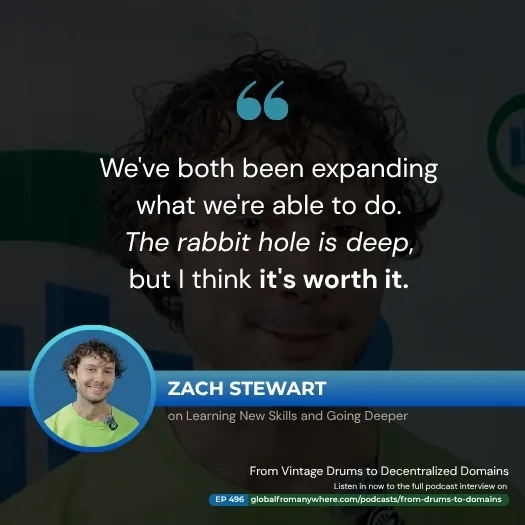
[58:59] We've both been expanding what we're able to do.
[59:03] The rabbit hole is deep, but I think it's worth it, right?
[59:06] Oh, it's definitely worth it, yeah.
[59:08] It's an experience, it's a good skill to learn, right?
[59:10] I mean, we need more technical people.
[59:11] I think the future is more and more technical.
[59:14] Yeah, I mean, going full circle back to the digital nomad part of it.
[59:19] I think it's more and more that's a useful skill that
[59:23] everyone will come in handy no matter what you're doing with business.
[59:28] We all need some website or online presence and this can help automate that and make it less like a thing you have to do manually.
[59:37] Great, man.
[59:38] Well, I dunno, I could link, I don't know if you if you have a website yet, or anything, or we could put it in the notes on the blog, or if you want to add anything else as far as the handshake or like my vibe-coded stuff, it's still all living on my computer.
[59:51] I don't have any website yet, but my drum business is counterhoop.com.
[59:57] Counterhoop, that's amazing.
[59:58] Yeah, it's like a term for a rim.
[1:00:02] The thing that puts pressure on the drum head, tunes the drum, makes the sound.
[1:00:08] Yeah, like that.
[1:00:09] Yeah, they used to call that the counter hoop.
[1:00:11] And then the hoop or the rim.
[1:00:13] Okay, got it.
[1:00:14] So, yeah, I was like reading through old drum catalogs when I was little and saw that word.
[1:00:20] Is that Red, or is that?
[1:00:21] Yeah, it was a handred.
[1:00:22] It was available.
[1:00:24] That was my first domain purchase.
[1:00:26] Sweet.
[1:00:27] Sweet.
[1:00:28] Great, Melke.
[1:00:29] Thanks for sharing.
[1:00:30] I had fun today.
[1:00:31] I finished my beer.
[1:00:33] yeah.
[1:00:33] Thanks for having me.
[1:00:35] Alright, thanks, everybody.
[1:00:36] See you next one.
Comments